Posted in April 24, 2024 ¬ 12:14 pmh.adminComments Off on Presenter Spotlight: 2024 ASA Beyond Valuation Professional Development and Growth Conference – Virtual
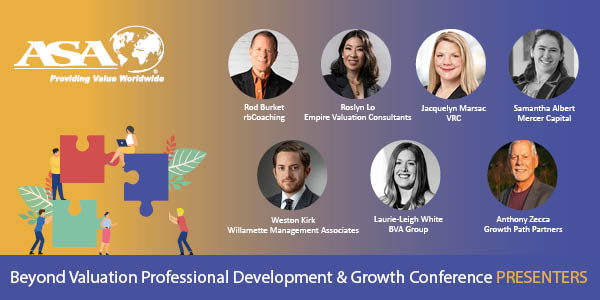
Join us for ASA’s Beyond Valuation Professional Development and Growth Conference, offering virtual attendance, taking place on May 29th, 2024 at 1:00 PM ET. Piece by piece, reach new heights with your business valuation career alongside industry professionals. Explore our comprehensive Conference Agenda to see sessions covering Business Development, Important Issues for the Next Generation of Valuers, and more. Don’t miss out—reserve your spot today to discover a pathway toward success as a distinguished business valuer by mastering pivotal skills that will distinguish you in the early stages of your career.
Our current lineup includes:
Rod Burket | rbCoaching In one way, shape, or form I’ve been performing valuations since the late 1980s. In July 2000, I started Burkert Valuation Advisors, LLC in Philadelphia where I ran a “traditional” valuation practice for 10 years. In March 2010, I began traveling full time throughout the US and Canada in an RV with my wife and our dogs. Later, I started rb Coaching, which morphed into rb Training, and rb Webinars – all in the BVFLS space. Today, I run a mobile consulting firm that includes my valuation practice, a report review service, online education, and a coaching business … all of which I built by leveraging my professional network and social media and hiring virtual assistants to make the available technology work for me.
Weston Kirk | Willamette Management Associates Weston Kirk is a managing director with Willamette Management Associates. He is also the director of the Atlanta office. His practice includes business valuation, economic analysis, and financial opinion services. Weston has performed various types of valuation and economic analyses, including business and stock valuations, debt and promissory note valuations, ESOP formation and adequate consideration analyses, fairness opinions, Internal Revenue Service audit rebuttals, litigation disputes and damages analyses, merger and acquisition valuations, undivided interests in real estate valuations, and intellectual property valuations.
Jacquelyn Marsac| VRC Ms. Marsac specializes in business enterprise valuations and intangible-asset valuations. Additionally, she completes valuations of financial instruments including preferred and common stock in complex structures for publicly and privately held companies and equity derivatives. Ms. Marsac holds the designations of both chartered financial analyst (CFA) and accredited senior appraiser (ASA). In addition, she holds a master’s degree in business administration and a bachelor’s degree in chemical and biomolecular engineering, both from Tulane University.
Roslyn Lo| Empire Valuation Consultants Roslyn specializes in real estate valuations of commercial properties of all types. She has performed valuations for purposes including financing, financial reporting, estate and gift tax planning, tax appeal, litigation, and eminent domain.
Samantha Albert | Mercer Capital Samantha Albert is a vice president with Mercer Capital. Samantha is experienced in the valuation of companies across a variety of industries, and has specific experience working with trucking companies and related enterprises as well as asset holding entities. Along with Nick Heinz, Samantha publishes research on valuation issues related to the trucking industry in the newsletter Value Focus: Transportation and Logistics. She is involved in the valuation of trucking companies for a variety of purposes including corporate planning, estate and gift tax planning, mergers and acquisitions, profit sharing plans, compliance matters, litigation support, and ESOPs. In addition, Samantha is a member of the firm’s Financial Reporting Valuation Group. She has experience providing valuation analyses related to intangible assets, contractual agreements, and complex capital structures. Samantha also works regularly on complex valuation assignments related to litigated matters.
Anthony Zecca | Growth Path Partners Anthony Zecca, CPA, is CEO of Growth Path Partners, a technical accounting and advisory firm focused on preparing and supporting companies through Mergers & Acquisitions, SPAC’s, IPOs, and Reverse Mergers. He was formerly a consultant with Esposito CEO2CEO, and is a retired partner at CohnReznick, where he was national director of the advisory group.
Laurie-Leigh White | BVA Group Laurie-Leigh White is a Partner with BVA Group and serves as the head of the firm’s Houston office. She is responsible for overseeing the execution of a variety of valuation and litigation engagements and specializes in the valuation of companies, partnerships, intangible assets, complex securities for financial reporting and tax purposes, and employee stock ownership plans. Laurie-Leight has been involved in thousands of valuation projects for a wide variety of purposes, including financial reporting, employee stock ownership plans, valuations for tax purposes, transaction advisory, and fairness opinions.
Posted in April 18, 2024 ¬ 10:00 amh.adminComments Off on ASA New York City Chapter Hosts Virtual Presentation: Heresy? Rethink & Quantification of Company-Specific Risk Premium
Join ASA’s NYC Chapter for a presentation by Ray Dragon, ASA, entitled Heresy? A Radical Rethink & Quantification of Company-Specific Risk Premium.
The presentation will cover the following: The Company-Specific Risk Premium (“CSRP”) is a foundational element of private company valuation; however, it is perhaps the most weakly supported element in theory and often arbitrary in practice. Join Ray Dragon, ASA for an explorative rethink of the premises of the CSRP and what it implies for a more accurate quantification of this important variable.
While tickets are free for ASA Members, please sign up with your email address for continuing education (“CE”) credit.
Speaker
Ray Dragon, ASA Director and Leader of the Valuation Practice at Anchin Ray has an MBA from Northwestern University’s Kellogg School of Management and a Masters in Financial Economics from the University of London. An executive with over 25 years of experience in valuation, M&A, corporate finance, forensic accounting, and expert testimony, Ray has the distinction of having served as President of both the New York City and Northern New Jersey ASA Chapters. Ray has an MBA from Northwestern University’s Kellogg School of Management and a Masters in Financial Economics from the University of London. His practice includes valuations for litigation, shareholder disputes, estate and gift planning, and financial reporting.
Posted in April 3, 2024 ¬ 9:33 amh.adminComments Off on ASA New York City Chapter Hosts Virtual Presentation: Appraising Handbags & Avoiding Counterfeits
While tickets are free for ASA Members, please sign up with your email address for continuing education (“CE”) credit.
Speaker
Graham Wetzbarger Founder & CEO, Luxury Appraisals & Authentication Graham Wetzbarger is a world-renowned expert of personal luxury goods, specifically in authentication and appraisals of collectible handbags jewelry and watches. Over the past 15 years, Graham has worked with some of the largest resale businesses including The RealReal, eBay, and Sotheby’s. His authentication expertise grew from his education in Fashion Design and Art History. His thirst for knowledge has taken him around the world, studying at some of the best institutions including the GIA, Christie’s, Fordham Law School, London College of Fashion, NYU, and FIT. Graham has spoken at SXSW, the Fashion Law Institute, Stern Business School, Southern Methodist University, and The Federal Bar Association. Graham donates his time as a National Board member of the Costume Society of America, a member of the Couture Council at FIT, and the International Trademark Association.
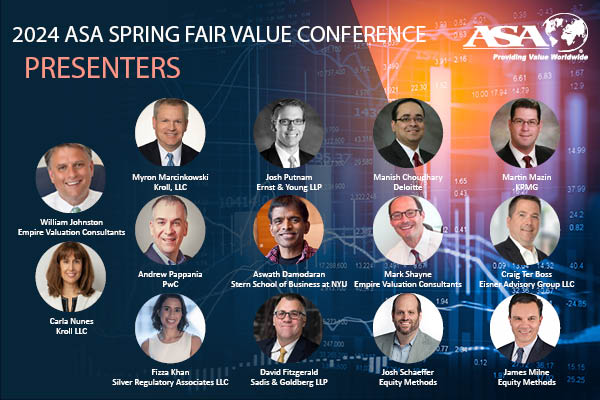
Join us for ASA’s Fair Value Conference, offering both in-person and virtual attendance options, taking place on April 25th, 2024 at 9:00 AM ET. Dive into the latest developments and trends in fair value alongside industry leaders. Explore our comprehensive Conference Agenda to see sessions covering risk measurement, ESG’s impact on valuations, and more. Don’t miss out—reserve your spot today to connect with peers and stay at the forefront of fair value discussions.
Our current lineup includes:
Myron Marcinkowski | Kroll, LLC Myron Marcinkowski joined Duff & Phelps (rebranded to Kroll) in 2006. He is a managing director and North American Valuation Services Leader and part of the firm’s Valuation Advisory Services practice. Myron is also the firm’s Consumer Products and Retail industry leader. He has more than 31 years of experience in providing valuation and financial advisory services.
Josh Putnam | Ernst & Young LLP Business valuation professional with extensive experience in the valuation of the business enterprise, equity and intangible assets. These valuations have been used by clients to support allocations of purchase price in corporate mergers and acquisitions (for both accounting and tax purposes), litigation and arbitrations, bankruptcy and reorganizations, estate and gift taxes and planning, and corporate planning and internal restructuring. Industry sectors include Media & Entertainment, Retail and Consumer Products and Private Equity.
Manish Choudhary, ASA, CFA| Deloitte Manish Choudhary is a Managing Director in Deloitte Advisory’s Valuation practice in New York. Manish has supervised and performed diverse valuation engagements for over 20 years involving business enterprises, intangible assets, equipment, and facilities. Manish manages and performs valuation studies in a variety of industries including technology, telecommunications, media, consumer business, health care, financial services and manufacturing for purchase price allocations, impairment testing, fair value reporting, mergers and acquisition analyses, tax and regulatory compliance, bankruptcy re-organizations and strategic financial planning.
Martin Mazin| KPMG Martin is a partner in the Economic & Valuation Services practice of KPMG LLP. He serves as the New York Metro market leader as well as the National Life Sciences Industry Leader for the valuation practice. Martin is also the former chair of the firm’s Valuation Services Technical Committee. He has approximately 20 years of valuation experience and has been responsible for and involved in a wide range of valuation assignments including, valuations of business and business interests, intangible assets, stock options, and preferred stock.
Andrew Pappania| PwC Andrew Pappania is a Principal in the Deals Practice concentrating in Valuation. He has performed valuations of businesses, both domestic and international, ranging in size from small, closely held businesses to Fortune 50 companies. He has performed appraisals for purposes such as reorganizations, acquisitions and divestitures, litigation support and for various tax purposes. Currently his projects focus on with issues surrounding financial reporting requirements (ASC 718, 805, 350 & 360 and 460-10) and US tax requirements (IRC 338(h)10, IRC 382). He currently leads PwC’s Beverages sector for Valuation Services.
Aswath Damodaran | Stern School of Business at New York University Aswath Damodaran holds the Kerschner Family Chair in Finance Education and is Professor of Finance at New York University Stern School of Business. Before coming to Stern, he also lectured in Finance at the University of California, Berkeley. Professor Damodaran’s contributions to the field of Finance have been recognized many times over. His skill and enthusiasm in the classroom garnered him the Schools of Business Excellence in Teaching Award in 1988, and the Distinguished Teaching award from NYU in 1990. In addition to myriad publications in academic journals, Professor Damodaran is the author of several highly-regarded and widely-used academic texts on Valuation, Corporate Finance, and Investment Management. Professor Damodaran currently teaches Corporate Finance and Valuation to the MBAs, and his interests lie in disentangling value drivers and understanding market pricing and behavior.
William Johnston, ASA | Empire Valuation Consultants Bill Johnston is an Accredited Senior Appraiser (ASA) of the American Society of Appraisers and was one of the first recipients of the ASA’s intangible asset designation. He has over twenty-nine years of experience in business and intangible asset valuations. Bill has managed and performed numerous valuations for financial reporting purposes, including purchase price allocation, goodwill impairment testing, and cheap stock (ASC 718/409a). He is a past member of the Board of Governors for the ASA and is Past Chair of the ASA’s Business Valuation Committee. He is also past President of the ASA’s New York City Chapter and chaired the first national conference co-sponsored by the ASA covering financial reporting valuations. Bill has acted as a guest lecturer at Fordham University, speaking on the topic of intangible asset valuation. He is a member of the Appraisal Foundation’s Working Groups on Valuing Contingent Consideration and Intangible Asset Discount Ratesand a member of the Appraisal Issues Task Force (AITF). Bill previously served as Empire’s chairperson for its Technical and Standards Committee and currently chairs an annual fair value conference and professional development conference for the ASA.
Mark Shayne, ASA, CPA, ABV, CGMA | Empire Valuation Consultants Mark is a Senior Managing Director of Empire Valuation Consultants. He is an Accredited Senior Appraiser (ASA) of the American Society of Appraisers, and is a Certified Public Accountant (CPA) and Accredited in Business Valuation (ABV) by the American Institute of Certified Public Accountants. Mark has over 25 years of valuation experience with operating, real estate and intangible assets. He also has extensive experience in the valuation of business interests and assets for purposes of Fair Value Measurement (ASC 820), Business Combinations (ASC 805), Property, Plant and Equipment (ASC 360-10), financial SEC reporting, fairness opinions, estate and gift tax and litigation. In addition, he has prepared and supervised over 3,000 valuations of direct and indirect investments in debt, equity and real-estate backed assets on behalf of major alternative asset managers, family offices and business owners worldwide.
Craig Ter Boss | Eisner Advisory Group LLC Craig Ter Boss is a Partner in the Corporate Finance Group, with nearly 20 years’ experience providing valuation services to public and private clients. Craig delivers services across a range of industries, including consumer products, apparel, technology, business services, financial services, manufacturing, media, retail and health care. Craig’s depth of experience and skill set is a unique combination, positioning him as a specialist with client-facing concerns as well as an expert in fair value measurement issues for audit engagements. Types of engagements include allocation of purchase price, goodwill impairment, corporate strategic and tax planning, corporate transactions (e.g., mergers, acquisitions), litigation and arbitration.
Fizza Khan | Silver Regulatory Associates LLC Fizza Khan is an expert on regulations governing investment advisers, broker-dealers and registered and private funds. As a hands-on leader across the firm’s flagship service lines – Regulatory Compliance, ESG and Due Diligence Preparation – Fizza ensures Silver’s clients are fully prepared to withstand regulator and investor scrutiny. Through leadership positions at compliance consultancies, in-house legal counsel and compliance roles at various financial institutions and law firm practice, Fizza developed an approach for her clients that calibrates best practices with their business realities. Having personally handled numerous SEC examinations while in-house and as a consultant, Fizza knows how to satisfy regulator and investor expectations without creating unmanageable complexity. Prior to founding Silver, Fizza was the Chief Operating Officer for U.S. Compliance Consulting and a Managing Director at Duff & Phelps. She joined Duff & Phelps in January 2016 as a result of their acquisition of CounselWorks LLC where she was a Partner. At both Duff & Phelps and CounselWorks, Fizza managed the day-to-day provision of compliance services to firm clients and built the foundations upon which advice was given.
David Fitzgerald | Sadis & Goldberg LLP David Fitzgerald’s practice focuses on investment funds, securities, joint ventures, regulatory compliance and investment advisers. He regularly structures and organizes hedge funds, private equity funds, funds of funds, separately managed accounts and hybrid funds. Additionally, he advises private fund managers on structure, compensation, employment and investor issues, and other matters relating to management companies. Drawing on his 16 years of experience as an institutional Chief Compliance Officer and General Counsel, David provides ongoing advice to investment advisers on securities law issues, including SEC filings. His practice also involves counseling clients in SEC regulatory matters, including compliance issues related to registered advisers.
Carla Nunes, CFA, ABV | Kroll LLC Carla S. Nunes, CFA, ABV is a Managing Director in the Office of Professional Practice of Kroll and a Kroll Institute Fellow. In addition, Ms. Nunes is the Global Leader of Kroll’s Valuation Digital Solutions group, which produces cost of capital thought leadership content and data housed in the Cost of Capital Navigator. She has over 25 years of experience in valuation, financial reporting and tax, conducting numerous business and asset valuations for a variety of purposes including purchase price allocations, goodwill and asset impairments, mergers & acquisitions, tax restructuring, debt analysis, and gift and estate tax planning. Ms. Nunes also has extensive experience working with multinational companies, having addressed complex tax, international cost of capital, and foreign exchange issues. She is a co-author of the “Valuation Handbook” series and co-creator of the Kroll Cost of Capital Navigator. Ms. Nunes is a Practitioner Director in the Board of FMA International.
Josh Schaeffer, Ph.D. | Equity Methods Josh Schaeffer is a managing director and practice leader for Equity Methods’ valuation practice. He leads the delivery of valuation and advisory services related to complex securities. Josh works closely with finance executives across a broad array of public and private firms. His clients range from early-stage, pre-IPO upstarts to some of the largest public companies in the world. He’s a frequent presenter for the National Association of Stock Plan Professionals, the American Society of Appraisers, and other industry organizations. Prior to joining Equity Methods, Josh worked with Deloitte Financial Advisory Services and Cornerstone Research. In these roles, he focused on valuations and statistical analyses of businesses and investments for financial reporting, tax, consulting, litigation, and arbitration purposes.
James Milne | Equity Methods James Milne is a manager for Equity Methods’ valuation practice. He brings a wide variety of practical business experience to the valuation and equity compensation space. James has worked closely with finance executives across a broad range of public and private firms. He manages teams in valuing a wide variety of derivative instruments pertaining to compensation agreements, private companies, partnerships, earn-outs, and guarantees. He has also valued the equity, debt and intangible assets of privately held firms spanning a large number of industries including financial services, real estate, entertainment, and consumer products. Prior to joining Equity Methods, James worked with Deloitte Financial Advisory Services and a number of small valuation firms including Simon Financial, and Cronkite & Kissell. In these roles, he focused on valuations for financial reporting, tax, consulting, litigation, and arbitration purposes.
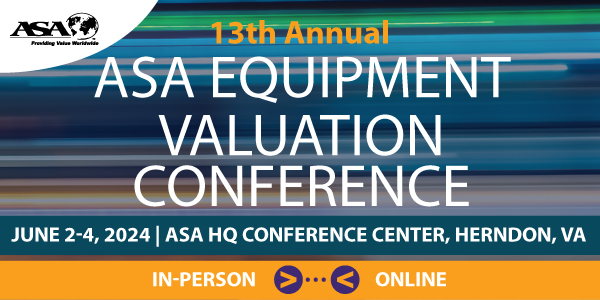
ASA’s 13th Annual Equipment Valuation Conference agenda presents an unmatched platform designed exclusively for professionals immersed in the intricacies of equipment appraisal and valuation. Get ready to be inspired by our distinguished lineup of presenters, each a trailblazer in their respective domains. As you embark on this enlightening journey, connect with the industry’s foremost appraisers, equipment management experts, and thought leaders. This conference is your gateway to a rare opportunity – a chance to gather insights from the best in the business and elevate your proficiency in equipment valuation.
Our Current Lineup Includes:
Marc Genest, Ph.D.| US Naval War College Professor Marc Genest, Ph.D., is the Forrest Sherman Professor of Public Diplomacy in the Strategy and Policy Department and area study coordinator for the insurgency and terrorism electives program. He has a doctorate in international politics from Georgetown University and is the founding co-director of NWC’s Center on Irregular Warfare and Armed Groups. He served two tours as a civilian advisor in Afghanistan and received the Commander’s Award for Civilian Service from the Army as a special advisor to the Commander of Task Force Mountain Warrior. He has written numerous books and articles on international relations, strategic communication and American foreign policy and public opinion.
Grant Nolen | Fusable Grant Nolen is a strategic and seasoned leader with a proven track record of managing dynamic teams, negotiating complex deals, and successfully closing contracts. Having spent his entire career in the construction industry, Mr. Nolen received his BA in Advertising Integrated Marketing Communications from Southern Illinois University, Carbondale. As a leader in the Asset Intelligence Division of Randall Reilly, Mr. Nolen manages EquipmentWatch’s sales team, works closely in collaboration with EquipmentWatch’s product and data teams to oversees API integrations, and regularly contributes to EquipmentWatch’s industry thought leadership through his monthly Market Reports, blogs, and white papers such as the recent State of the Construction Equipment Economy.
F99F1EKham Inthirath | Compound Effect Meet Kham Inthirath, the innovative CEO of Compound Effect, who brings a unique blend of over two decades of marketing expertise and insights from his experiences as a monk. A Massachusetts native and dedicated father of four, Kham embodies his philosophy, ‘It takes a village,’ in both his personal and professional life. His leadership has propelled businesses to significant growth, with some clients experiencing over 90% revenue increases, and others seeing AI streamline weeks of work into mere minutes. Currently spearheading an AI-driven content creation project, Kham is at the forefront of building an AI virtual team that redefines business automation and efficiency. A firm believer in the principle, ‘If you are not uncomfortable, you are not growing,’ he inspires his audience to embrace the transformative power of AI. Join his session for an enlightening blend of innovative business strategies and compelling life lessons.
Derek Marcello | Regions Equipment Finance Corp Derek Marcello is a Senior Vice President, Head of Asset Management at Regions Equipment Finance Corporation. Derek has 30 years of extensive equipment and transaction evaluation experience in the corporate finance and leasing industry. He is a distinguished leader in Asset Management having worked at top banks and has built several asset management platforms driving best practices. Derek earned a Bachelor of Science in Management and M.B.A in Global Leadership with minor in Marketing. He is a career member of the American Society of Appraisers (MTS) and the Equipment Leasing and Finance Association.
Richard A. Berkemeier, ASA | Pegasus Aircraft Appraisal Group Richard Berkemeier, ASA, is an established senior appraiser who has owned and operated Pegasus Aircraft Appraisal Group (https://pegasusappraisal.com/), one of the world’s largest aircraft, helicopter, and parts appraisal firms, since 2008. His strong passion for appraisal, valuation, and economic proposition related to aircraft and his expertise on this subject matter have taken him around the world, educating groups at the Big-4, Marsh, Siemens Financial, JaSIA, DLL, and many other businesses across six continents. He has taught appraisal classes in Russia, England, Japan, Australia, Germany, Korea, South Africa, Brazil, Argentina, Netherlands, Saudi Arabia, and Canada. Berkemeier has been instrumental in ASA’s course development and instruction, particularly for ASA’s Aircraft Valuation Program (http://www.appraisers.org/aircraft). He is also a certified Uniform Standards of Professional Appraisal Practice (USPAP) instructor for personal property; a frequent presenter at many educational conferences and programs tailored to aviation valuation professionals; and author of numerous articles published in ASA’s Machinery & Technical Specialties Journal. Berkemeier has held multiple leadership positions in ASA, most notably serving International President.
Fernando Sosa, ASA, MRICS | Marshall & Infrastructure Inc. J. Fernando Sosa is a Director in the Energy & Infrastructure Practice of Marshall & Stevens Incorporated. He is co-leader of its Chicago E&I region and oversees the execution of valuation consulting services to the firm’s public and privately held clients. For 24 years Mr. Sosa has specialized in valuation and cost estimates of tangible assets and integrated projects/facilities both domestic and international. Independent valuation consulting and opinions are provided for buy/sell consideration, mergers, acquisitions, divestitures, and financings, financial reporting, tax reporting, bankruptcy/restructuring, feasibility, and matters of dispute including litigation support. He is fluent in Spanish and has performed appraisals for clients throughout the United States and for multinational clients in England, Spain, México, Panamá, Dominican Republic, Chile, El Salvador, Colombia, and Puerto Rico. Mr. Sosa is responsible for the valuation of residential, commercial and industrial, community, distributed generation, and utility scale solar electric generation projects and portfolios, wind electric generation projects, stand-alone energy storage, microgrids, and renewable natural gas projects. He works with our Financial Valuation Practice on financial reporting analyses. He leads the valuation of facilities to qualify for repowering (“80/20 test”). Tax reporting assignments are most commonly provided for compliance with Internal Revenue Code Sections 861, 382, and 704(c), cost segregation (MACRS) and personal property tax. Financial reporting assignment including purchase price allocations (ASC 805), impairment testing (ASC 350 and 360), and fresh start accounting (ASC 852). Mr. Sosa has served clients in a variety of industries including aviation, construction, energy generation, entertainment, food processing, hospitality, manufacturing, medical imaging, plastic injection molding, retail, semiconductor, steel reprocessing, transportation, waste collection and recycle, water/wastewater treatment plants, and other infrastructure projects. Employment: Prior to rejoining Marshall & Stevens, Mr. Sosa served in senior roles at Cushman & Wakefield, CohnReznick, and American Appraisal Associates. He started his valuation career in American Appraisal’s Public Accounting Service Group. He was employed by Marshall & Stevens from 2002-2005.
Greg Mergen, AM | International Machinery Exchange Greg Mergen is President of International Machinery Exchange. Founded in 1979, IME specializes in selling new and used machinery and process systems for food processing plants in around the world. Greg performs appraisals nationwide and has been engaged with consulting projects in may US locations, as well as facilities in Mexico, Central and South America and Asia.
Harry Ward | DLS Marine Thomas Rechen is an accomplished trial lawyer and business litigator with three decades of experience handling complex business disputes on behalf of public and private companies in Connecticut and across the nation. He is well known among the Connecticut state and federal judiciary as a result of his courtroom presence and leadership within the Connecticut and Hartford County Bar Associations.
This month we spotlight updates on the search for a new CEO, and a discussion of the work of ASA’s Board of Governors.
CEO Search Update
Our CEO Search Committee has received over 75 applications for our open Chief Executive Officer position. The posting will remain open through the end of March, with our search committee starting their work in upcoming weeks to screen applicants and conduct the first round of interviews. Final interviews, which will be conducted by our Board of Directors, are scheduled for mid-May, and we hope to have a CEO hired soon after that.
How the Board of Governors Works
One of the challenges within ASA is understanding how all the pieces of elected leadership–at the chapter, discipline, and international level–work together and how they interact with our CEO and ASA staff. While addressing how ASA uses “policy governance,” our model of governance, is much too long for this message, I thought I’d give an example of how it can sometimes work.
The Gems & Jewelry (GJ) Committee had recently discussed changes to how GJ candidates can become Accredited Members. GJ is unique within ASA in that its designation requires a gemology diploma, such as those offered by the Gemological Institute of America (GIA) or the Gemmological Association of Great Britain (GEM-A). Additionally, GJ requires the review and approval of two demonstration reports that not only satisfy ASA Board of Examiner requirements but also meet discipline standards on the research and analysis for each valued item and require the student to explain their research, analysis, calculations, and conclusions.
Because of GJ’s additional requirements, which are above and beyond those required by The Appraisal Foundation, the GJ committee requested changes in the ASA accreditation process to allow their candidates an option to rely on a combination of market-related personal property non-appraisal experience and appraisal experience to earn their designations.
A formal proposal was developed by Gems & Jewelry Committee Chair Mary Reich with assistance from members of the Board of Governors. It included necessary changes to the ASA operational manual and directed ASA headquarters staff to make necessary changes to the GJ accreditation guide.
The Board of Governors reviews such changes to ensure they are in the best interests of not only the discipline but also of ASA as a whole. It is important for ASA to maintain the high standards of professionalism and competence that are expected by our existing members and the public. The GJ proposal was approved at the January Board of Governors meeting and is currently being implemented. It allows ASA to streamline the process for highly qualified candidates to become full members and should allow ASA to grow its membership.
Posted in March 6, 2024 ¬ 9:14 amh.adminComments Off on Elevate Your Appraisal Career: Five Ways Belonging to ASA Can Help You Find Your Ideal Job or Start Your Practice
Joining a professional organization can be a game-changer for your career, and for those in the appraisal profession, ASA stands out as a leading choice. Beyond networking and professional development, being a part of ASA can be instrumental not only in securing a job but also in laying the foundation for launching your appraisal practice. In this article, we explore five ways ASA membership can contribute to your job search success or entrepreneurial endeavors.
Networking Opportunities:
ASA’s extensive network of professionals in the appraisal profession is not only a gateway to job opportunities but also a valuable resource for aspiring entrepreneurs. Establishing connections with experienced appraisers, industry experts, and potential business partners within the ASA community can provide insights into market trends, business strategies, and potential clients. Networking through ASA can be a crucial stepping stone toward building a robust client base for your appraisal practice. Visit ASA’s Find an Appraiser online search tool.
Access to Exclusive Job Listings and Business Opportunities:
ASA membership doesn’t just grant access to job listings—it also opens doors to potential business opportunities. Whether you’re seeking employment or contemplating entrepreneurship, ASA regularly shares exclusive job openings and business prospects within the profession. This unique access allows you to explore not only job roles but also potential partnerships or avenues to kickstart your appraisal venture. Visit ASA’s Job Bank and Career Center.
Professional Development and Certification for Business Success:
Pursuing ASA accreditations and engaging in professional development programs not only enhances your skills for job applications but also equips you with the expertise needed to run a successful appraisal practice. Clients often seek appraisers with recognized credentials and a commitment to excellence. By obtaining ASA accreditations, you not only increase your employability but also establish a solid foundation for building trust and credibility as a business owner. Learn more about ASA’s Education and Credentialing Programs.
Industry Recognition and Credibility for Entrepreneurial Ventures:
Launching your appraisal practice requires a high level of credibility and industry recognition. ASA membership signifies your dedication to ethical conduct, continuous learning, and adherence to industry best practices—attributes that can significantly bolster your business’s reputation. Clients and partners are more likely to trust an appraiser with an ASA affiliation, giving your entrepreneurial endeavor a competitive edge in the market. Learn more about ASA’s high standards, ethics, and policies that set members apart.
Mentorship and Support:
ASA has an active Mentor Program for those who would like help navigating the accreditation process. The ASA community offers valuable mentorship opportunities and support for aspiring entrepreneurs. Engaging with seasoned professionals who have successfully navigated the accreditation landscape can provide invaluable insights, guidance, and encouragement. ASA members often share their experiences, challenges, and successes, creating a supportive environment that can empower you to confidently pursue your accreditation. Learn more about ASA’s active mentor program for those looking for help getting started.
Conclusion:
Belonging to ASA not only enhances your chances of securing a job but also lays a solid foundation for entrepreneurial success. From networking opportunities to access to exclusive job listings and business prospects, ASA membership equips you with the tools and connections needed to thrive in both traditional employment and entrepreneurial ventures. Embrace the advantages of ASA membership, and embark on a career path that not only fulfills your professional aspirations but also allows you to chart your course as a successful appraisal business owner.
Are you ready to take your career to new heights and explore the exciting possibilities within the appraisal profession?
Join ASA today to connect with industry leaders, access exclusive opportunities, and pave the way for a fulfilling and successful career. Visit the ASA website or call (800) 272-8258 and become a part of a dynamic community dedicated to excellence in appraisal. Your journey towards professional growth and entrepreneurial success begins with ASA membership.
Posted in March 1, 2024 ¬ 7:57 amh.adminComments Off on ASA New York City Chapter Hosts Virtual Presentation: Appraisers, Insurance, & High Net Worth Private Collections
Join ASA’s NYC Chapter for a presentation by Barbara Chamberlain, Director, Art Services, Private Client Select Insurance Services, LLC. The presentation is entitled Appraisers, Insurance & High Net Worth Private Collections and will cover how personal property appraisers can work with insurance professionals in the high-net-worth private collections space.
The insurance industry depends on accurate valuations—from determining coverages to adjusting claims. Barbara will talk about the role of appraisals from the insurance company perspective, illustrated with real world examples and practical tips for appraisers of personal property.
While tickets are free for ASA Members, please sign up with your email address for continuing education (“CE”) credit.
Speaker
Barbara Chamberlain Director, Art Services, Private Client Select Insurance Services, LLC
Barbara has more than 25 years of experience in private, public, and corporate art collections, museums, and galleries. After beginning her career managing works of art in a contemporary art gallery in New York City, she was assistant curator of The FORBES Magazine Collection. More recently, she was the registrar at the Appleton Museum of Art in Ocala, Florida. She joined AIG Private Client Group (now Private Client Select) in 2008 and continues to provide collections management and care, risk management, and loss prevention services to policyholders.
She is a member of the Executive Board of the Friends of the Uffizi Gallery and a member of the Board of Directors for the Association of Registrars and Collections Specialists (ARCS).
Barbara holds a Bachelor of Arts degree in Art History and Psychology from Smith College. She earned a Master of Arts in Museum Studies at Johns Hopkins University where she now teaches the first course in private collectors, collections, and museums.
Dear ASA Family, as I embark on the next chapter in my career, I wanted to express my deep gratitude and heartfelt farewell to the incredible ASA community. During my tenure as your CEO, I have had the opportunity to meet many of our great members around the world and learn so much about the valuation profession. The decision to assume the role of CEO at the American Association of Clinical Endocrinology was not made lightly, and it comes with mixed emotions as I leave behind an organization that has been an integral part of my life.
Since my announcement last month, I have been working alongside the team to ensure a seamless transition. The search for a new CEO is in capable hands with a dedicated search committee and the expertise of Association Strategies, Inc. I have utmost confidence that they will find a leader who will carry the ASA’s legacy forward and continue the good work I have started with the team.
Reflecting on our shared journey, I am immensely proud of the milestones we achieved together:
Restoring financial health.
Navigating challenges during the pandemic.
Launching the groundbreaking COVID-19 News Portal.
Transitioning the governance structure.
Upgrading technology platforms.
Relocating ASA’s headquarters strategically.
Strengthening global relationships and raising ASA’s brand awareness.
Initiating successful publications and transforming educational platforms.
Taking a leadership role in addressing unconscious bias in real property appraisal.
These achievements are a testament to the collective dedication and spirit of the ASA community. As I step into this new chapter, I leave ASA in a positive position for the future.
Over the coming weeks headquarters staff, international officers, and the Board of Governors will ensure a smooth transition. The capable hands of the senior management team, led by Chief Operating Officer Bonny (Price) Rogers and Chief Partnership Officer John Russell, will guide ASA until a new CEO is appointed.
For those interested in more details about ASA’s CEO transition and search, please refer to this month’s Message from the International President, Garrett Schwartz.
My sincere appreciation goes out to each one of you for your unwavering dedication, confidence, and support throughout these years. I will genuinely miss the collaborative spirit and the vibrant energy of the ASA community. The knowledge and experience I gain as your leader will stay with me forever and I will be an advocate for the valuation profession for life.
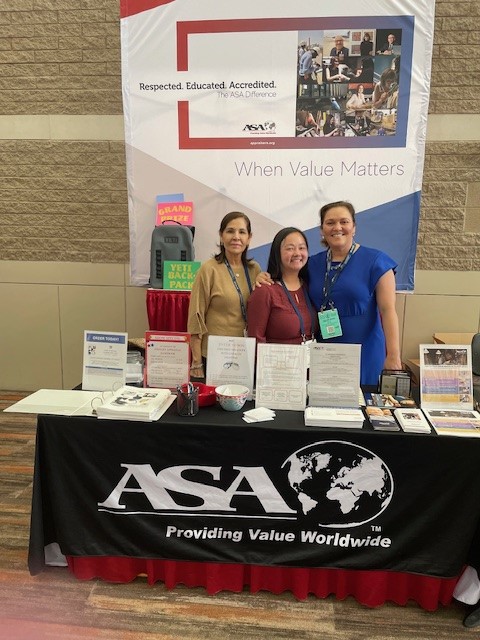
The 2024 AGA Tucson Conference, held on January 31 at the Tucson Marriott University Park, featured a comprehensive agenda from 8:00 am to 4:30 pm, concluding with a dazzling Gala from 7:00 pm to 9:00 pm. The sessions covered a range of gemologist-focused topics, with ASA proudly participating as an Emerald Sponsor. Theresa Brossmer ASA, ARM, MGA®, provided on-site support, organizing a sponsor table featuring ASA’s gems and jewelry marketing materials.
Olga Diaz De Leon, Christine Ratanadilok, and Dr. Celine Rose David, PhD Dr. David will be speaking at the 2024 ASA International Conference in Portland, OR. Her topic will be about cuts of antique diamonds.
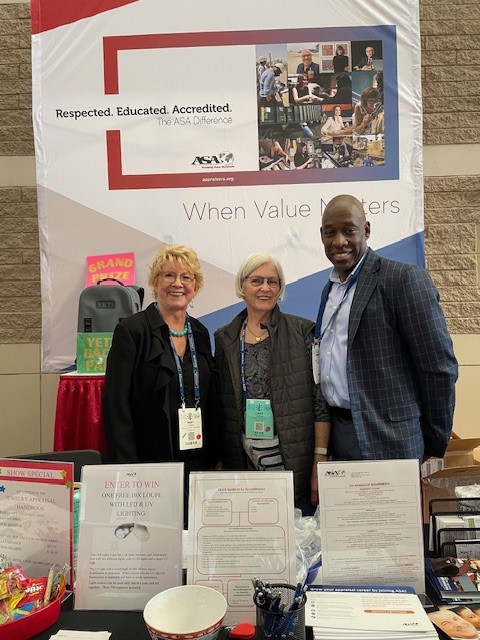
The booth showcased gems and jewelry marketing handouts, along with enticing ASA-branded promotional items, including pens, 5x plastic loupes, phone chargers, and a coveted Yeti Backpack grand prize. 10X-powered loupes were also given away in a drawing for five days, which was a huge draw to the booth. The ASA Jewelry Appraisal Handbook was also prominently displayed and available for purchase.
Attendees had the opportunity to engage with the ASA team, including discussions about becoming appraisers, as well as learning about ASA’s gems and jewelry education, credentialing, and membership programs. A lead retrieval system facilitated the collection of crucial information for follow-up recruitment efforts.
This year’s event marks the conclusion of Marti Hubbard’s impactful service. ASA CEO Johnnie White honored her with a plaque, expressing gratitude for her significant contributions. Christine Ratanadilok, and Olga <Last Name>, who supported Marti’s efforts this year, are set to take over responsibilities for next year’s conference.
Marti Hubbard, ASA MGA®, Linda Sandvall, and Johnnie White Linda was the winner of the 10 X LED/UV loupe on Wednesday.
ASA extends heartfelt thanks to all the member volunteers whose support was instrumental in making these two events a success.